
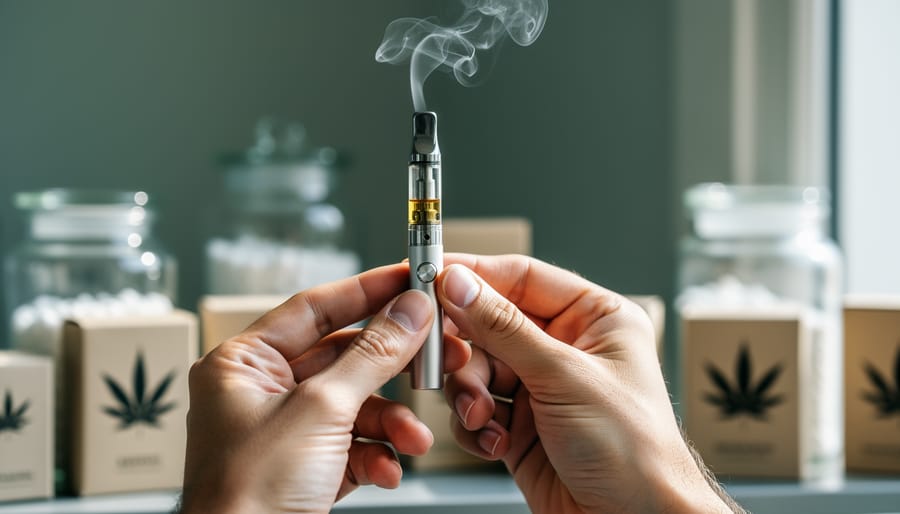
Vaping hemp-derived cannabis involves selecting a quality cartridge or disposable device containing federally legal cannabinoids like delta-8 THC or CBD, charging or preparing your device, and inhaling slowly for three to five seconds to gauge effects. The entire process takes minutes to set up once you understand the key difference: hemp-derived products contain less than 0.3% delta-9 THC, making them legal under federal law while still delivering relaxation, focus, or mild euphoria depending on the cannabinoid profile. If you’re ready to explore options, shop now to find beginner-friendly products.
Most people considering hemp vaping come from two backgrounds. Some have experience with traditional smoking vs vaping methods but want legal access without dispensary requirements. Others are entirely new to cannabinoids and drawn to wellness benefits like stress relief or better sleep. Both groups need the same foundation: understanding what you’re inhaling, how to choose trustworthy products, and how to start with doses that won’t overwhelm you.
Hemp-derived vaping offers significant advantages over smoking. You’ll experience faster onset than edibles, usually within five to fifteen minutes, and avoid the combustion byproducts that come with joints or pipes. The discreet nature appeals to users who value privacy, and precise dosing becomes possible once you learn your tolerance.
Safety starts with product selection. Third-party lab reports verify cannabinoid content and screen for pesticides, heavy metals, and cutting agents. Reputable brands publish these certificates openly. If a product lacks testing documentation, skip it entirely. The hemp market remains loosely regulated compared to state-licensed marijuana, so your diligence protects your health.
This guide walks you through equipment selection, safety checks, step-by-step vaping technique, and how to verify you’re using products correctly and safely.
Understanding Hemp-Derived Cannabis Products
Hemp-derived cannabis products come from the same plant species as marijuana, Cannabis sativa, but with one critical legal distinction: they must contain no more than 0.3% Delta-9 THC by dry weight. This threshold, established under the 2018 Farm Bill legality framework, transformed hemp from a controlled substance into an agricultural commodity, creating a legal pathway for various cannabinoid products.
The most common hemp-derived cannabinoids you’ll encounter in vape products each offer distinct effects. CBD (cannabidiol) produces no intoxication but may offer relaxation and stress relief. Delta-8 THC delivers a milder psychoactive effect than traditional marijuana, users describe it as a clear-headed, functional high with less anxiety. Delta-9 THC, when derived from hemp at legal concentrations, produces effects nearly identical to marijuana-derived Delta-9, though dosing per serving remains restricted. HHC (hexahydrocannabinol) sits between CBD and Delta-8 in potency, offering subtle euphoria. THC-O, a synthetic acetate derivative, carries significantly higher potency, often 2-3 times stronger than Delta-9, and requires extreme caution for new users.
Potency varies dramatically. A CBD cartridge won’t get you high at all, while a THC-O product might overwhelm someone expecting a Delta-8 experience. Manufacturers often blend cannabinoids, creating complex effects profiles that differ from single-compound products. Check the label’s cannabinoid breakdown and total milligrams per cartridge before your first puff.
Legal status remains complicated. Federal law permits hemp-derived cannabinoids, but individual states have banned or restricted Delta-8, THC-O, and other compounds. Some states treat all THC identically regardless of source. Before purchasing, verify your state’s current regulations, what’s legal federally might land you in trouble locally. This patchwork creates real legal risk that shifts as you cross state lines.
What You’ll Need to Get Started
Choosing Your Vaping Device
Your first device choice shapes your entire vaping experience, so match it to your specific needs rather than chasing the most advanced option.
If you’re buying pre-filled hemp-derived cartridges or disposables, a simple 510-thread battery gives you the easiest entry point. These batteries cost $15, $30, require no maintenance beyond charging, and work with nearly every cartridge brand. Look for variable voltage settings (2.4V, 3.8V range) so you can adjust heat, lower temperatures preserve flavor and reduce harshness, while higher settings produce thicker vapor. Avoid the cheapest stick batteries that lack voltage control; you’ll regret having no way to fine-tune your experience.
Pod systems offer more convenience if you prefer closed systems with less mess. Brands create proprietary pods that snap into dedicated batteries, eliminating threading issues and leakage. You’ll pay $25, $50 for the battery and $20, $40 per pod, but you gain consistent performance and easier cartridge changes. The trade-off: you’re locked into that brand’s pod selection.
For those using hemp flower rather than concentrates, dry herb vaporizers heat ground cannabis without combustion. Entry-level models start around $60, $80, while quality devices run $100, $200. They demand more learning, packing chambers correctly, finding your ideal temperature (350°F, 385°F for hemp), but deliver cleaner flavor and more efficient extraction than smoking.
Budget $20, $40 total if you’re testing hemp-derived vaping with a basic battery and one cartridge. Committed users should invest $50, $100 upfront for better devices that’ll last.
Selecting Quality Hemp-Derived Products
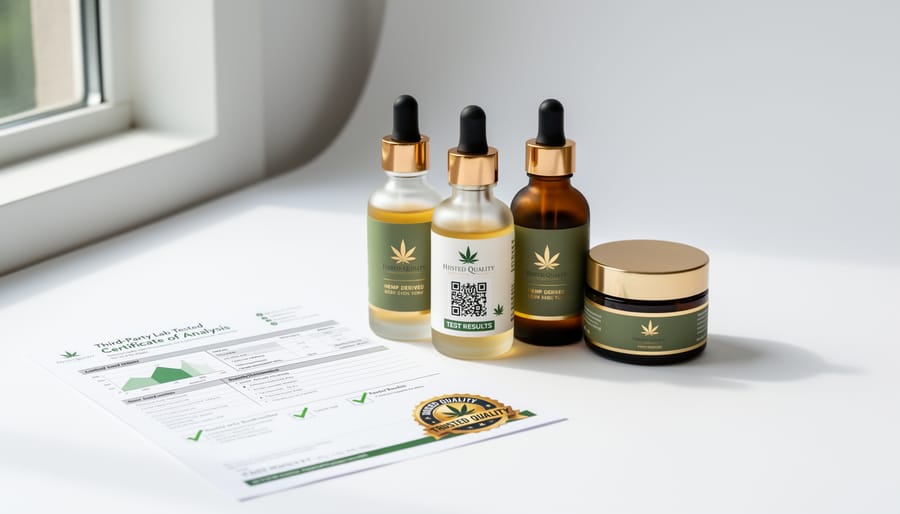
The quality of your hemp-derived vape products directly determines your experience and safety. Start by verifying that any cartridge or concentrate you consider has been tested by an independent, third-party laboratory, not just the manufacturer’s in-house facility. Legitimate brands readily provide certificates of analysis (COAs) that detail cannabinoid content, confirm the absence of harmful contaminants like heavy metals, pesticides, and residual solvents, and verify the product contains less than 0.3% Delta-9 THC as required by federal law.
When reviewing a COA, check that the testing date is recent (within six months) and that the batch number matches your product. The cannabinoid profile should list all major compounds present, Delta-8, Delta-9, CBD, CBN, or whatever the product claims, with percentages that align with label claims. If a cartridge advertises 900mg of Delta-8 but the COA shows only 600mg, you’ve found a red flag.
Ingredient transparency matters equally. Quality manufacturers list every component: the cannabinoid distillate or isolate, natural terpenes for flavor, and any carrier oils. Avoid products with vague “proprietary blends” or those containing vitamin E acetate, which has been linked to serious lung injuries. Cutting agents like propylene glycol (PG) and vegetable glycerin (VG) are generally considered safe in moderation, but hemp-derived cannabis cartridges should rely primarily on cannabis-derived terpenes rather than synthetic additives.
Research brands before buying. Look for companies with established reputations, transparent sourcing practices, and responsive customer service. Read verified customer reviews on independent platforms, not just the brand’s website. Reputable retailers stock products from manufacturers who prioritize testing, use clean extraction methods, and stand behind their quality with batch-level traceability.
Safety Precautions and Warnings
Avoiding Contaminated or Unsafe Products
The hemp-derived cannabis market lacks the regulatory oversight of licensed marijuana dispensaries, making product quality wildly inconsistent. Here’s how to spot unsafe products before they end up in your lungs.
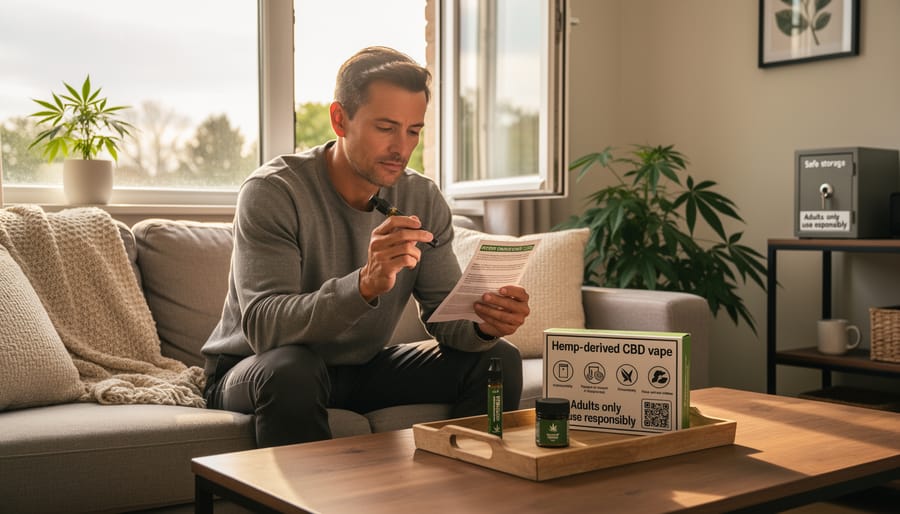
Start by demanding third-party lab results, certificates of analysis (COAs) that test for potency, contaminants, and purity. Legitimate brands display these openly on their websites or product packaging with scannable QR codes. If a company won’t provide lab results or makes them difficult to find, walk away. No exceptions.
Watch for red flags in pricing. A cartridge selling for $10 when competitors charge $30-40 isn’t a bargain, it’s a warning sign. Quality extraction, testing, and ingredients cost money. Suspiciously cheap products often skip testing or use low-grade materials.
Check ingredient lists carefully. Avoid products containing vitamin E acetate, which has caused serious lung injuries. Steer clear of vague terms like “natural flavors” or “proprietary blend” without specifics. The ingredient list should be short and recognizable: cannabis extract, plant-derived terpenes, and perhaps a food-grade carrier like MCT oil.
Heavy metals (lead, arsenic, mercury) and pesticides can concentrate in cannabis extracts. Reputable labs test for these contaminants specifically. Review COAs for passing results on these safety panels, not just cannabinoid percentages.
Purchase from established retailers with verifiable business addresses and customer reviews spanning multiple platforms. Gas stations and unbranded websites carry higher risk than specialty vape shops or known online retailers with transparent sourcing practices.
Dosage and Tolerance Considerations
Starting with hemp-derived cannabinoids requires a cautious approach because potency varies significantly between products and individuals respond differently. Begin with one or two short puffs, around three seconds each, then wait at least 15 minutes to assess the effects before considering more. This “start low and go slow” principle prevents the uncomfortable experience of overconsumption.
Hemp-derived Delta-8 THC typically produces milder effects than Delta-9, while compounds like THC-O and HHC can be surprisingly potent. Product labels may list percentages, but these don’t always translate predictably to your experience. Factors like your body weight, metabolism, whether you’ve eaten recently, and previous cannabis exposure all influence how you’ll respond.
If you’re completely new to cannabis products, treat your first session as purely exploratory. Choose a time when you have no obligations and can remain home safely. Many people find effects more intense than expected, even from products marketed as mild.
Tolerance builds with regular use, but this doesn’t mean you should chase stronger effects by increasing frequency or dose. Cycling your use, taking breaks of a few days between sessions, helps maintain sensitivity and reduces the risk of dependence. If you find yourself needing significantly more to achieve the same effect, that’s a signal to pause rather than escalate.
Step-by-Step Guide to Vaping Hemp-Derived Cannabis
Preparing Your Device
Before taking your first draw, spend a few minutes setting up your device properly. This simple preparation prevents frustration and ensures a smooth vaping experience.
Start by charging your battery if it’s rechargeable. Most cartridge batteries arrive partially charged, but a full charge prevents interruptions during your first session. Connect the USB charger to a power source and wait until the indicator light shows completion, usually 1-2 hours for a fresh battery.
Next, attach your cartridge or pod firmly but gently. For 510-threaded cartridges, screw clockwise until snug, stopping when you feel resistance. Over-tightening damages the connection and causes leaks. Pod systems simply click into place. You’ll hear or feel a snap when properly seated.
Inspect the cartridge for leaks by holding it upright and checking the mouthpiece and base for oil seepage. Wipe away any residue with a clean cloth. A small air bubble inside the cartridge is normal and helps regulate flow.
Finally, test airflow before activating the device. Take a gentle pull without pressing the button. You should feel slight resistance but smooth passage. Completely blocked airflow indicates a clogged cartridge, while zero resistance suggests a loose connection. Some devices require one or two dry pulls to prime the heating element before first use.
Proper Inhalation Technique
Your inhalation technique significantly impacts both the effects you experience and how comfortable the process feels. Unlike traditional smoking, vaping hemp-derived cannabis requires a gentler, more controlled approach to avoid throat irritation and achieve optimal vapor delivery.
Start with slow, steady draws lasting three to five seconds rather than quick puffs. A controlled inhale allows the heating element to vaporize cannabinoids efficiently without burning the concentrate, which produces smoother vapor and preserves flavor. Quick, sharp puffs often result in harsh hits that irritate your throat without delivering more cannabinoids.
Most beginners should use a mouth-to-lung technique, similar to sipping through a straw. Draw vapor into your mouth first, then inhale it into your lungs with a small breath of fresh air. This method provides better control and feels less intense than direct-lung hits, where you pull vapor straight into your lungs like taking a deep breath. Direct-lung technique works better for experienced users with high-wattage devices, but it’s unnecessarily harsh for hemp-derived cannabis cartridges.
After inhaling, hold the vapor in your lungs for two to three seconds, then exhale slowly. Extended breath-holding beyond five seconds doesn’t increase absorption, your lungs absorb most cannabinoids within the first few seconds. Following these techniques will help you vape properly and avoid common mistakes like coughing fits or wasted product.
Between draws, wait at least thirty seconds to let the heating element cool and the wick re-saturate with concentrate. This prevents dry hits and extends your cartridge’s lifespan.
Managing Your Session

Start with 1-2 short puffs for your first session, especially if you’re new to hemp-derived cannabinoids or unsure of the product’s potency. This conservative approach lets you gauge effects without overshooting your comfort zone.
After those initial draws, set your device down and wait at least 5-10 minutes before deciding whether to continue. Hemp-derived cannabis vapor takes time to reach peak effects, many beginners make the mistake of taking multiple hits in quick succession, then feeling overwhelmed 15 minutes later. Mark the time on your phone if needed. Use this waiting period to assess how you feel: notice any changes in mood, physical sensations, or mental clarity.
You’ve had enough when you experience the desired effects, whether that’s relaxation, mild euphoria, or pain relief, without discomfort. Warning signs you’ve overdone it include racing thoughts, dizziness, increased heart rate, or paranoia. If this happens, find a comfortable spot, drink water, and remind yourself the feeling will pass within a couple hours.
Between sessions, store your device upright in a cool, dry place away from direct sunlight. Extreme temperatures degrade cannabinoids and can cause leaks. If your cartridge has an airflow control ring, close it to prevent clogs. Keep devices out of reach of children and pets, and never leave them in hot cars where they can leak or the battery can degrade.
Recognizing Effects and Adjusting Your Approach
What to Expect and When
Understanding the timeline of hemp-derived cannabis vaping helps you recognize when effects begin and avoid taking too much too quickly. Most users feel initial effects within 5 to 15 minutes after their first few puffs. The sensation typically builds gradually rather than hitting all at once, so patience is essential for beginners.
Effects usually peak between 30 and 60 minutes after vaping, when cannabinoid levels in your bloodstream reach their highest concentration. This is when you’ll experience the strongest sensations, whether that’s relaxation, mood elevation, or physical comfort. The overall experience generally lasts 2 to 4 hours, though some residual effects may linger slightly longer.
Different cannabinoids produce distinct timelines and intensities. Delta-8 THC tends to offer milder, more gradual effects than Delta-9 THC, which can feel more potent and immediate. HHC falls somewhere between the two, while CBD produces minimal psychoactive effects regardless of dose. Your individual metabolism, tolerance, body weight, and whether you’ve eaten recently all influence how quickly and strongly you feel effects. This variability explains why starting with minimal puffs and waiting the full 10 minutes between sessions prevents accidental overconsumption during your first experiences.
Troubleshooting Common Issues
When your hemp-derived cannabis vaping experience isn’t quite right, a few simple adjustments usually solve the problem. Most issues stem from device settings, cartridge condition, or dosage rather than defective products.
Common problems and quick fixes:
- No vapor production, Check that your battery is charged and the cartridge is properly connected with clean contact points
- Harsh or irritating throat hit, Lower your device voltage or wattage; start around 3.2-3.7V for most cartridges
- Clogged cartridge, Gently warm the cartridge with your hands or a hairdryer on low, then take a few primer puffs without firing the battery
- Effects feel too strong, Reduce your dosage to single small puffs and wait longer between sessions
- Weak or no effects, Ensure you’re inhaling into your lungs (not just holding vapor in your mouth) and verify your product’s COA shows adequate cannabinoid content
If your cartridge tastes burnt, stop using it immediately, you’ve likely depleted the oil or overheated the coil, and continuing will only worsen the experience. A metallic taste often indicates the coil is damaged and should be replaced.
For persistent problems that simple fixes don’t resolve, contact the retailer or manufacturer rather than continuing to use a malfunctioning product. If you experience effects that feel unsafe or unmanageable, stop vaping, move to a calm environment, drink water, and remember that hemp-derived cannabinoid effects are temporary. Don’t hesitate to reach out to a trusted friend or medical professional if you feel you need support.
Maintenance and Long-Term Use
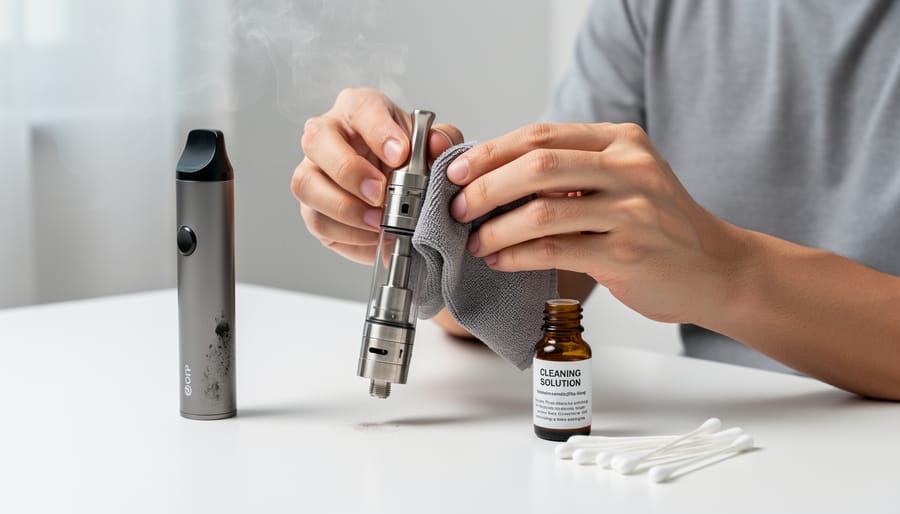
Building good maintenance habits now will keep your vaping experience smooth and help your equipment perform reliably whether you’re using hemp-derived cannabis to resign from smoking or for other wellness purposes. Proper care extends the life of your devices and ensures consistent vapor quality.
Clean your battery’s connection points every week or two by gently wiping the threading with a cotton swab dipped in rubbing alcohol. Let it dry completely before reattaching cartridges. This prevents oil buildup that can cause poor electrical contact and weak hits. If you notice reduced vapor production despite a fresh cartridge, dirty connections are often the culprit.
Store your devices and cartridges upright in a cool, dark place away from direct sunlight and heat sources. Temperatures above 75°F can cause oil to thin and leak, while extreme cold makes it too viscous to vaporize properly. A drawer or dedicated case works perfectly. Keep cartridges sealed when not in use to prevent oxidation, which can darken the oil and alter flavor over time.
- Wipe battery contacts weekly with alcohol-dampened cotton swab
- Store devices upright at 60-75°F away from sunlight
- Watch for flavor changes or thin vapor indicating cartridge depletion
- Charge batteries before they fully drain to extend lifespan
- Replace devices showing burnt taste, battery failure, or connection issues
You’ll know a cartridge is nearly empty when the oil level drops below the intake holes, flavor becomes muted or burnt, and vapor production weakens noticeably. Don’t try to squeeze out every last drop; hitting an empty cartridge can burn the coil and produce harsh, unpleasant vapor.
Charge your battery when it reaches about 20 percent rather than letting it die completely. This charging pattern extends battery lifespan significantly. If your device starts taking multiple clicks to fire, won’t hold a charge, or produces inconsistent vapor, it’s time for a replacement.
Frequently Asked Questions
Will hemp-derived cannabis vaping show up on a drug test?
Yes, most hemp-derived cannabinoids, including Delta-8, Delta-9 THC, HHC, and THC-O, can trigger positive results on standard drug tests that screen for THC metabolites. Even CBD products containing trace amounts of THC may cause failed tests, so avoid these products if you’re subject to workplace or legal drug screening.
Is hemp-derived cannabis legal in all states?
No, while the 2018 Farm Bill federally legalized hemp-derived products containing less than 0.3% Delta-9 THC, individual states have passed their own restrictions. States like Alaska, Colorado, Delaware, and New York have banned or heavily regulated Delta-8 and similar cannabinoids, so check your local laws before purchasing or possessing these products.
How does vaping compare to smoking hemp flower?
Vaping typically provides faster effects and higher bioavailability than smoking, meaning you absorb more cannabinoids with less product. It’s also smoother on the throat and lungs since there’s no combustion, though the long-term safety of inhaling vaporized oils still requires more research compared to the well-documented risks of smoking.
How long do hemp-derived vape cartridges last?
An average 1ml cartridge contains roughly 200-300 puffs and typically lasts 1-4 weeks depending on your usage frequency. Store cartridges upright in a cool, dark place to preserve potency, cannabinoids degrade when exposed to heat and light, and most products maintain quality for 6-12 months when stored properly.
Can I travel with hemp-derived vape devices?
Domestic air travel with hemp-derived vapes falls into a legal gray area, while TSA doesn’t specifically search for cannabis products, you could face issues in states where these cannabinoids are banned. Never travel internationally with any cannabis products, including hemp-derived ones, as most countries maintain strict prohibition regardless of U.S. federal hemp laws.
Beyond these common concerns, many people switching from traditional marijuana or CBD products wonder about potency adjustments. Hemp-derived cannabinoids vary widely in strength, Delta-8 is roughly half as potent as Delta-9 THC, while THC-O is potentially stronger than traditional marijuana. Start with smaller doses than you’d use with other products and give yourself at least a week to assess how each cannabinoid affects you personally before increasing intake.
If you’re transitioning from smoking to vaping, expect some adjustment in how effects feel. The high from vaping often comes on faster but may feel slightly different in character, more clear-headed with Delta-8, for instance, compared to the full-spectrum experience of smoking flower. This isn’t necessarily better or worse, just different, and most users adapt within a few sessions once they learn their preferred draw technique and dosage.
Vaping hemp-derived cannabis can be a safe, controlled way to explore these products when you approach it thoughtfully. Start with quality-tested items from reputable sources, choose equipment that matches your experience level, and always verify lab results before your first session. Remember that patience is your best ally, begin with one or two small puffs, wait at least ten minutes to gauge effects, and resist the urge to rush the process.
Your body provides valuable feedback. Pay attention to how you feel, adjust your approach based on actual results rather than expectations, and never hesitate to scale back if something doesn’t feel right. Keep your device clean, store products properly, and stay informed about the evolving regulatory landscape in your area.
Whether you’re transitioning from traditional methods or exploring cannabinoids for the first time, this journey works best when you prioritize safety over speed. If you ever feel uncertain about product quality, dosing, or effects, reach out to knowledgeable retailers or healthcare providers who understand these products. Making informed choices means you can enjoy the benefits while minimizing risks. Take your time, trust the process, and vape responsibly.


